We may earn a commission if you buy through our links, at no extra cost to you. Products are selected for usefulness, not commission rate.
Essential kitchen tools are the small number of reliable items that support the meals you actually prepare: a safe cutting surface, a comfortable knife, useful scissors, a few task-specific cutters, practical storage, and a sink setup that is easy to clean. A good kitchen is not defined by how many gadgets it contains. It is defined by whether common work can be done safely, efficiently, and without searching through crowded drawers.
This guide explains how to build a practical set of essential kitchen tools, compare materials and designs, organize them by task, and maintain them. The recommendations are intentionally evidence-based: seller titles can suggest a use, but current dimensions, materials, food-contact claims, cleaning instructions, and included parts should always be verified on the product page. Browse Sundoa’s Kitchen Tools and Appliances collection alongside the checklist below.
Choose a kitchen tool for a task you repeat
Start with the task, not a matching gadget set. Scissors are worth comparing if you regularly open packages or snip herbs; a wheel cutter is more relevant if you often portion pizza. Skip either if a tool you already own handles the job comfortably.
These are listing-based comparisons, not hands-on tests. Sundoa may earn a commission from qualifying purchases through the links below, at no extra cost to you. Confirm the selected variant, current price, delivery and return terms on AliExpress.
Multipurpose kitchen scissors
Compare the handle opening, blade length and hinge-cleaning access. Confirm the selected model’s intended food-prep uses and care instructions; do not assume every variant has detachable blades or the same cutting capacity.
View product details · Check price and options on AliExpress
Pizza wheel cutter
Compare the wheel size, finger clearance and cleaning access around the axle. Check the dimensions against your drawer space, and choose a cutting surface suitable for the wheel.
View product details · Check price and options on AliExpress
Essential kitchen tools: the quick answer
Start with one dependable chef-style knife, kitchen scissors, a stable cutting board, a safe storage method, a can or bottle opener suited to your routine, and simple tools for the foods you make regularly. Add a pizza cutter, ice tray, separator jar, or sink dispenser only when it solves a repeated task. Choose comfortable handles, easy-to-clean construction, stable contact surfaces, and materials documented for the intended use.
- Buy for repeated tasks, not novelty.
- Prefer tools that can be cleaned completely and dried easily.
- Separate raw-food equipment and follow current food-safety guidance.
- Store blades so edges and hands are protected.
- Do not infer food-contact safety from appearance alone.
- Check current seller specifications before ordering.
Essential kitchen tool comparison
| Tool | Useful for | What to check | Sundoa example |
|---|---|---|---|
| Chef-style knife | Everyday slicing and preparation | Comfort, controllable size, edge care, and protected storage | Kitchen chef knife set |
| Kitchen scissors | Packages, herbs, and suitable food-prep tasks | Grip, hinge cleaning, blade separation, and intended use | Multipurpose kitchen scissors |
| Pizza cutter | Portioning pizza and other flat foods | Guard position, handle control, wheel cleaning, and storage | Stainless-steel pizza cutter |
| Separator jar | Draining and serving suitable pickled foods | Capacity, lid seal, cleaning access, and food-contact documentation | Pickle and olive separator jar |
| Sink dispenser | Reducing bottle clutter near the sink | Mounting dimensions, refill access, tube length, and material care | Kitchen sink soap dispenser |
Use the table as a decision filter, not a shopping checklist. Start with the Kitchen collection or narrow the selection to Kitchen Tools and Appliances, then verify the current product dimensions, materials, included parts, and care instructions.
Audit your kitchen before buying
For one week, note every kitchen task that feels slow, awkward, or messy. Examples might include opening packages, cutting herbs, portioning pizza, draining brine from olives, filling an ice tray, dispensing soap, or finding a usable knife. Repeated friction reveals where a tool can help. A task performed once a year rarely justifies permanent drawer space.
Then empty one drawer or work area and group existing tools by function: cutting, turning and mixing, opening, measuring, serving, storage, and cleaning. Remove duplicates that are uncomfortable, damaged, or never used. Do not discard a specialized item until confirming it is not required for a dietary, cultural, accessibility, or household need.
Measure available storage and work surfaces. A long knife set, tall dispenser, or wide tray may be useful but unsuitable for the space. Record drawer depth, counter clearance, sink-hole dimensions where relevant, and dishwasher restrictions. Fit is a product requirement, not an afterthought.
Build around tasks, not matching sets
Matching sets look organized but often include shapes a household does not need. A task-based set can combine one good knife, one pair of scissors, one pizza cutter, and a few storage tools from different manufacturers. Performance, comfort, and cleaning matter more than visual uniformity.
Create a core layer and an optional layer. Core tools support daily preparation and cleanup. Optional tools support frequent personal habits, such as opening wine, making ice, serving pickled foods, or preparing pizza. This structure prevents a specialty item from displacing a tool used every day.
When replacing a failed tool, identify the failure. A handle may have become slippery, a hinge trapped food, a blade was difficult to sharpen, or the product did not fit the drawer. Choose the next tool to correct that specific problem rather than buying the same design again.
Chef knives and basic cutting
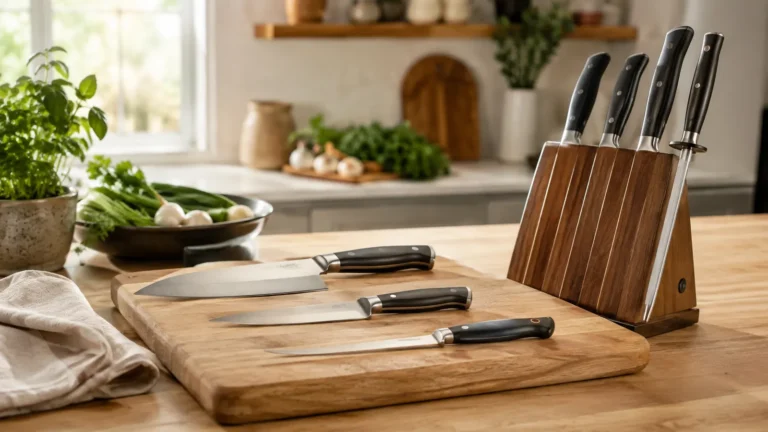
A chef-style knife handles many tasks when its size, balance, and edge suit the user. The carbon stainless-steel kitchen chef knife set is one catalog example. The product page should be checked for the exact steel description, blade sizes, included pieces, handle material, care instructions, and storage. “Carbon stainless steel” is a broad description, not a complete performance specification.
Comfort is personal. A handle should allow a secure grip without sharp pressure points. The blade should feel controllable rather than simply heavy. Users with smaller hands, limited grip strength, or joint pain may prefer different handle shapes. When possible, compare dimensions with a knife already comfortable at home.
Use a stable cutting board on a level surface. A damp towel or suitable nonslip mat beneath the board can reduce movement when appropriate. Keep the guiding hand’s fingertips tucked away from the edge and cut at a controlled pace. A dull knife can slip because it requires extra force; maintain the edge according to the maker’s guidance.
Kitchen scissors: useful when they come apart cleanly
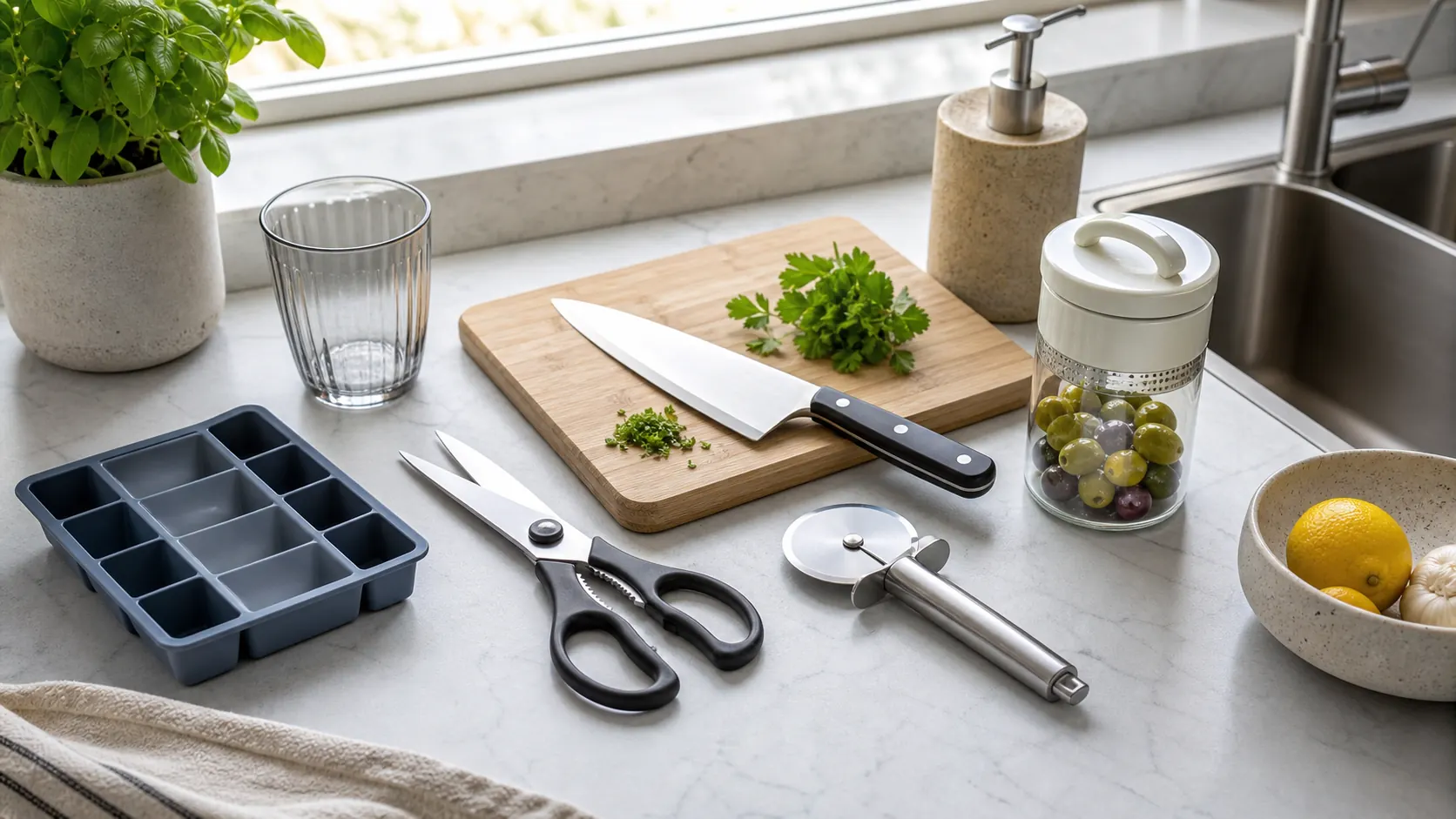
Kitchen scissors can cut herbs, parchment, food packaging, and suitable ingredients. The multipurpose kitchen scissors listing is marketed for food preparation. Verify what materials and food types the current seller actually supports, because heavy bone cutting places very different stress on a tool than herbs or packaging.
The pivot area is critical. Food residue can collect where blades overlap. Scissors that separate for cleaning may be easier to sanitize, provided the mechanism locks securely during use. If they do not separate, open them fully and clean the hinge as directed. Dry immediately, especially around joints and serrations.
Keep food scissors separate from craft or household scissors. Color coding or labeled storage prevents someone from using kitchen scissors on cardboard, tape, wire, or other materials that contaminate or damage the blades. Do not catch a falling pair; step back and pick it up after it lands.
Pizza cutters and rolling blades
A rolling pizza cutter is useful when pizza, flatbread, or suitable dough is prepared frequently. The stainless-steel pizza cutter is a simple example. Compare wheel diameter, handle clearance, finger protection, axle construction, and cleaning access. A decorative wheel that wobbles or traps food is less useful than a plain stable cutter.
Use it on a surface that tolerates the blade and does not slide. Keep fingers out of the cutting path and push with controlled pressure. Do not use a pizza wheel for hard frozen food, bones, or packaging unless the manufacturer explicitly permits it.
Clean around the axle immediately because cheese and sauce can dry in the narrow gap. Rotate the wheel carefully while keeping fingers away from the edge. If the wheel loosens, corrodes, or develops rough movement, stop using it until it can be repaired or replaced safely.
Openers and multifunction tools
A bottle opener or corkscrew earns space when it matches beverages regularly served at home. The portable multifunction corkscrew and bottle opener combines several functions. Combination tools save space, but each mechanism should lock or operate securely and provide enough leverage for the user.
Inspect hinged tools before use. Loose pivots, bent metal, damaged screws, or a distorted corkscrew can cause slipping. Keep folding blades closed during storage and open only the implement needed. Use the tool on a stable bottle placed away from the edge of the counter.
If a household member has limited hand strength, a larger dedicated opener may be safer than a compact travel design. Accessibility is a valid reason to keep two tools that perform a similar task.
Ice trays and cold storage accessories
The silicone honeycomb ice tray listing illustrates a covered flexible mold. Before using any tray for food or drinks, verify the current seller’s material and food-contact documentation, temperature guidance, cleaning method, and included lid.
A lid can reduce spills and freezer odor exposure, but it may not make a tray leakproof. Carry a filled tray level and leave appropriate expansion space. Place it on a stable freezer shelf until solid. Flexible trays release ice easily when supported from below; aggressive twisting can spill cubes or damage thin areas.
Wash before first use and after exposure to strong odors or residue. Dry fully before stacking to avoid trapped moisture. If silicone becomes torn, sticky, permanently odorous, or difficult to clean, replace it.
Separator jars for olives and pickles
A separator jar can keep solid food and brine in the same container while making serving less messy. The hourglass separator jar for pickles and olives is designed around that idea. Verify material, seal design, capacity, temperature limits, and whether the current listing describes it as suitable for the intended food.
Do not assume a decorative seal is leakproof. Test over a sink with water before storing brine, and keep the container upright unless the manufacturer explicitly supports other orientations. Follow refrigeration and food-storage guidance for the actual contents.
Complex channels and seals must be cleaned thoroughly. Disassemble only as directed, inspect gaskets, and dry parts before reassembly. Discard a container with cracks, persistent odor, damaged seals, or surfaces that cannot be cleaned.
Sink-side soap dispensers
A dispenser can reduce bottle clutter and make dishwashing liquid easier to reach. The 2-in-1 sink soap dispenser with extension tube is one compact approach. Compare mounting method, tube length, bottle compatibility, pump material, countertop or sink-hole fit, and access for refilling.
Measure before ordering. Sink decks vary in thickness and hole diameter, and plumbing below the sink can block a large bottle. Keep the tube away from sharp edges and moving cabinet hardware. Use only liquids compatible with the pump; very thick or particulate products may clog it.
Prime according to the instructions and wipe spills promptly. Periodically rinse the pump path if allowed. A leaking dispenser can damage cabinet surfaces, so inspect connections and the bottle after refilling.
Touch-sensor faucets: plan the installation
A touch or sensor faucet can reduce handle contact during messy preparation, but it is a plumbing and power-dependent fixture rather than a countertop gadget. The black touch-sensor kitchen faucet is a catalog example. Verify installation dimensions, water connections, power requirements, operating mode, finish, included hardware, pressure range, and local plumbing compatibility.
Consider failure behavior. Can water still be controlled manually if batteries or power fail? Is the sensor likely to be triggered while cleaning the sink? Can the control box remain dry and accessible below the counter? Professional installation may be appropriate when plumbing changes are required.
Clean the finish only with permitted products. Abrasives and harsh chemicals can damage coatings. Follow local water regulations and inspect connections after installation.
Cups and everyday serving tools
A multipurpose cup seems simple, but material and use limits still matter. The Cozy Cup listing is marketed for several beverages. Confirm volume, material, temperature suitability, cleaning instructions, and whether it is intended for hot liquids before use.
Choose cups that are stable, comfortable to grip, and appropriate for the user’s mobility. A wide base can reduce tipping, while a heavy vessel may be difficult for some people. Avoid sudden temperature changes unless the material supports them, and retire chipped or cracked drinkware.
Materials: what the label does and does not tell you
Stainless steel
Stainless steel is common in blades and tools because it can resist corrosion, but grades, heat treatment, thickness, finish, and construction vary. “Stainless” does not mean maintenance-free. Wash, dry, and store the product according to its instructions. Rust-like marks can arise from contamination or unsuitable cleaning.
Silicone
Silicone can be flexible and useful across temperature ranges when properly specified. Verify food-contact and temperature information. Thin silicone can tear, absorb odor, or deform under unsupported weight. Inspect flexible products regularly.
Plastic
Plastic varies by formulation and intended use. Check food-contact documentation, heat limits, stain behavior, and dishwasher guidance. Replace items that crack, warp, develop rough surfaces, or retain residue.
Wood and bamboo
Wooden handles and boards need controlled washing and thorough drying. Prolonged soaking can swell, split, or loosen components. Follow care guidance for oiling or sanitizing and replace deeply cracked surfaces that cannot be cleaned effectively.
Design a safe cutting station
Place the cutting board on a stable surface with enough room for the knife and ingredients. Keep a discard bowl nearby so scraps do not crowd the board. Position the knife with the edge away from the work-area boundary and the handle visible. Do not hide a knife under towels, packaging, or food.
Use separate procedures for foods that require cross-contamination controls and follow current official food-safety guidance. Wash hands and equipment at the required points. A specialized gadget does not replace proper cleaning.
When carrying a knife, hold it securely with the point down and announce movement in a shared kitchen. Never leave blades in a sink of water where they cannot be seen. Wash one at a time and dry according to the maker’s instructions.
Organize drawers by frequency and risk
Daily tools belong in the most accessible zone. Specialty tools can use a secondary drawer or labeled container. Heavy items should not rest on fragile ones. Blade edges need guards, a suitable block, magnetic storage designed for the purpose, or another method that prevents contact.
Use dividers that fit the drawer and do not slide. Leave enough clearance so tools do not jam against the cabinet above. Avoid overfilling; if a tool must be forced into place, it will be difficult to retrieve safely.
Review the drawer every few months. Remove broken items, return borrowed tools, and note anything that is never used. Clear storage makes cooking faster because every remaining item has an assigned role.
Cleaning workflow after cooking
Clean sharp and food-contact tools before residue dries. Separate disassemblable parts only according to instructions. Use the recommended water temperature and detergent, paying attention to hinges, seals, handles, and axles. Dishwasher-safe claims should be verified per product; high heat and aggressive detergent can damage edges, coatings, adhesives, wood, and some plastics.
Dry completely before storage. Moisture trapped in a knife block, scissor pivot, jar gasket, or dispenser connection encourages odor and deterioration. Store flexible items without sharp folds and keep blades from contacting each other.
Inspect during cleaning. Look for loose handles, cracked plastic, rough silicone, bent edges, damaged seals, and corrosion. Stop using a product when damage affects safe cleaning or control.
How to avoid gadget clutter
Use a one-task threshold: a new gadget should solve a problem that occurs often enough to justify storage and cleaning. Then use a one-in, one-out review when the new item duplicates an old one. The old tool does not have to be discarded immediately, but compare them during real use and keep the safer, more comfortable option.
Beware of products that combine many unrelated functions. Multifunction design is valuable when each part is accessible, cleanable, and strong enough. It is poor value when attachments are difficult to store or one damaged mechanism makes the whole tool unpleasant.
Choose visual calm. Matching colors are optional; consistent storage positions are more useful. A kitchen can contain different materials and still feel organized when tools are grouped by task and counters remain clear.
Common buying mistakes
Buying a large knife set before learning preferences: start with the shapes actually used.
Ignoring cleaning access: hinges, seals, and axles can trap residue.
Assuming all stainless steel, silicone, or plastic is equivalent: verify the specific product’s intended use.
Choosing by novelty: repeated usefulness matters more than a clever demonstration.
Skipping measurements: sink fittings, drawers, and appliances have physical constraints.
Using one tool beyond its purpose: misuse damages edges, pivots, surfaces, and sometimes the user.
Three everyday kitchen workflows
Fast breakfast preparation
Keep the breakfast workflow compact: one cutting board, one suitable knife, one cup or bowl, and the tools needed for the household’s normal meal. Store coffee, tea, or cereal accessories together so opening several drawers is unnecessary. Fill ice trays and clean the separator jar during the previous cleanup rather than at the busiest moment. A clear counter section makes the routine faster than another specialized gadget.
After preparation, wash the sharp tool immediately and return it to protected storage. Wipe spills around the sink dispenser before they become sticky. The goal is a reset state: the board dry, blade stored, cup washed, and counter available for the next person.
Weeknight dinner
Before heat is applied, set out the cutting board, knife, scissors if needed, scrap bowl, and utensils. Prepare ingredients in an order that supports food-safety controls and reduces repeated washing. Use scissors only for tasks documented by the maker and keep them separate after contact with raw ingredients. Place a towel where it cannot touch flame, hot surfaces, or knife edges.
During cooking, return each tool to a designated resting place. Do not drop knives or scissors into a crowded sink. A pizza cutter, opener, or serving tool should be ready before the hot food arrives. This simple staging reduces rushed searching and makes specialty tools genuinely useful.
Serving guests
Choose tools that can be operated confidently by the host or assign one person to open bottles and portion food. Test corkscrews and dispensers before guests arrive. Use stable serving containers and keep allergens, dietary needs, and food-temperature guidance in the plan. A separator jar can make olives or pickles easier to serve, but it should remain upright if its seal has not been verified for carrying.
Afterward, separate sharp cleanup from general dish collection. One person can wash knives and scissors while other items wait visibly. Inspect glass, ceramic, and plastic for damage before storage. Hosting is easier when the tool set is familiar rather than newly purchased for the event.
Accessibility and shared-kitchen design
Tools should fit the people who use them. Larger handles can help some users, while others need lighter weight or shorter blades. High-contrast handles may be easier to locate. A touch faucet can reduce twisting but may introduce sensor or power complexity. A compact multifunction opener may save space but require more grip strength than a dedicated lever design.
Place frequently used tools within a comfortable reach range. Avoid forcing someone to lift a heavy knife block from a high shelf or reach across a hot surface. Drawer organizers should open fully without jamming. Labels can use words, simple icons, or tactile markers as appropriate.
Ask users directly what feels safe. A tool that appears ergonomic may not suit a particular hand, posture, or movement. Build the shared set around the widest practical range of users and keep an alternative where one design cannot serve everyone.
When a single-purpose tool is worth the space
A single-purpose tool earns its place when it performs a frequent task more safely, cleanly, or consistently than a general tool. A pizza wheel can portion pizza without dragging toppings. A separator jar can reduce brine spills. An ice tray with a lid can stack more neatly. The value comes from repeated use, not the novelty of the mechanism.
Before buying, estimate use frequency and cleaning time. A gadget used twice a year but requiring several parts to be washed may not help. Borrowing, renting, or using an existing general tool can be more sensible. For a task repeated every week, the same cleaning effort may be worthwhile.
Give the product an assigned storage location before it arrives. If no safe location exists, solve storage first or choose a smaller design. Countertop clutter makes every other task slower.
Budget priorities
Spend where control and safety matter: a comfortable knife, stable board, reliable scissors, and appropriate storage. Save on simple accessories when their materials and construction are documented for the use. A low price is not a reason to accept a tool that cannot be cleaned, measured, or handled safely.
Replace by condition and utility, not fashion. A plain tool that remains secure and clean does not need replacement because a matching set appears. When upgrading, identify the measurable improvement: better grip, safer storage, easier cleaning, correct dimensions, or reduced leakage.
Online prices and seller details change. Compare total cost, current specifications, and whether missing accessories or installation add expense. A dispenser that needs an unavailable bottle adapter or a faucet that needs professional modification may cost more than the product page first suggests.
Create a maintenance record
A simple note can track knife sharpening, dispenser cleaning, seal inspection, and replacement dates for flexible products. This is especially useful in a shared kitchen where no one person sees every task. Keep instructions for unusual disassembly or care.
Do not turn the record into bureaucracy. Note only maintenance that prevents a real problem. A monthly drawer check can identify loose handles, rust, damaged silicone, and missing guards in a few minutes. Correct small issues before the next busy meal.
A simple tool-selection scorecard
Score a possible purchase from one to five in six areas: task frequency, comfort, safe control, cleaning access, storage fit, and evidence on the current product page. A specialty tool used weekly with a secure handle, simple cleaning, and an assigned drawer can justify its place. A visually clever product with unclear materials and no storage location should wait.
Repeat the score after a month of use. If the tool remains hard to clean, duplicates another item, or never leaves the drawer, remove it from the prime work zone. If it saves time and remains easy to maintain, keep it accessible. This small review turns purchasing into an improving kitchen system rather than a growing collection.
Use the same scorecard when replacing an old favorite. A familiar shape may deserve priority even when a newer product offers more functions. The replacement should preserve the comfort and control that worked while correcting the original failure.
Frequently asked questions
What are the essential kitchen tools for a beginner?
A stable cutting board, comfortable general-purpose knife, kitchen scissors, basic opening and measuring tools, mixing and turning utensils, and safe storage cover most routines. Add specialty tools only for foods and tasks prepared regularly.
Is a knife set better than one chef knife?
A set can be useful when every included shape has a role, but one comfortable general-purpose knife plus a smaller knife may cover many households. Compare steel, construction, fit, care, and storage rather than piece count.
Can kitchen scissors go in the dishwasher?
Only when the manufacturer says so. Dishwasher heat and detergent can affect blades, pivots, coatings, handles, and sharpness. Even dishwasher-safe scissors should be dried around the hinge before storage.
How do I choose a pizza cutter?
Look for a stable wheel, comfortable handle, finger clearance, minimal wobble, and cleaning access around the axle. Choose a size appropriate to the food and storage space, and use it only on suitable surfaces.
Are silicone ice trays safe?
Use products documented for food contact and the intended temperature range. Follow cleaning instructions, inspect for damage and odor, and replace trays that become torn, sticky, or impossible to clean.
Do touch faucets work without power?
Behavior differs by model. Some provide manual operation while others depend on batteries or an adapter for sensor functions. Verify failure behavior, installation, and power requirements on the current product page before purchase.
How should knives be stored?
Use a method that protects the edge and prevents hands from contacting it: suitable guards, blocks, drawer inserts, or magnetic systems installed for the purpose. Keep blades dry and avoid loose storage where they strike other tools.
How often should kitchen tools be replaced?
Replace based on condition, not a universal date. Cracks, loose handles, corrosion, damaged seals, unstable hinges, rough food-contact surfaces, or loss of safe control are reasons to repair or retire a tool.
How can I make a small kitchen more efficient?
Keep daily tools accessible, group by task, use vertical or drawer storage safely, remove duplicates, and keep counters clear. Choose multipurpose tools only when they are easy to clean and genuinely replace several items.
What should I verify on an online product page?
Check exact dimensions, included parts, material specification, food-contact and temperature information where relevant, care instructions, compatibility, installation needs, and current seller terms. Do not rely on the title alone.
Final kitchen tools checklist
- Each tool supports a repeated task
- Handles fit the intended users
- Food-contact and temperature use are documented
- Hinges, seals, and axles can be cleaned
- Blades have safe storage
- Sink and drawer products have been measured
- Care instructions match the household routine
- Damaged products are repaired or retired
The most useful kitchen tools become almost invisible in daily life: they fit the hand, complete the task, clean easily, and return to a known place. Build the collection slowly, verify materials and dimensions, and let repeated cooking reveal what deserves space. That creates a safer and more capable kitchen than any oversized gadget bundle.